Video turns memory into observable evidence
Players, parents, and coaches remember games differently. Video provides a shared record of positioning, support, puck decisions, transitions, effort, recovery, and what happened before and after a play. It can slow the conversation down and replace vague comments such as “work harder” or “move the puck faster” with a specific moment the player can understand.
More footage is not always more useful
A full-game review can be valuable for advanced tactical questions, team systems, scouting, or a coach who needs to study every repetition. For many young and developing players, however, reviewing an entire game can create more observations than they can realistically act on at once.
A focused review of three submitted shifts creates room to explain the important moments in detail. The reviewer can identify what the player did well, select one or two development priorities, and connect each point to a practical coaching cue or training suggestion. That is often easier for the player to use than a long list of every possible issue.
Why a three-shift review can work
Three shifts do not establish everything about a player. They are a development snapshot, not a ranking, recruiting evaluation, or complete scouting report. Used honestly, they can still reveal useful patterns:
- Where the player starts before the puck arrives
- How the player supports teammates with and without the puck
- Whether decisions change under pressure
- How quickly the player transitions after possession changes
- What happens after a mistake, lost battle, shot, or pass
If the three shifts show conflicting evidence, a responsible review should say so instead of forcing a conclusion.
Aim for about 90 seconds per clip
For the clearest review, aim for approximately 90 seconds per submitted clip when possible. That usually provides the full shift plus useful context before the player enters the main action and after the immediate play ends.
Longer and shorter clips can still be reviewed. The key is player visibility and enough context to understand the sequence. Avoid cutting immediately at the shot, turnover, or whistle if doing so hides the setup or recovery. When possible, include about 5–10 seconds before and after the shift.
What a detailed player review should include
A useful review should do more than label plays as good or bad. Parents should expect:
- Specific evidence: what happened in the submitted footage
- Strengths: decisions, habits, or effort the player should keep repeating
- Constructive criticism: a limited number of changes explained without embarrassing the player
- A coaching cue: a short phrase the player can remember during practice or a game
- A training suggestion: an age-appropriate drill or practice focus connected to the observed issue
- Honest limits: what cannot be concluded from the available shifts
Use a strength, priority, and next-action conversation
Parents do not need to replay every criticism in the car. Start with one strength the player can recognize. Choose one priority that would make the biggest difference. Finish with one action for the next practice or game.
A simple example is: “Your support position gave your teammate an outlet. On the next similar play, scan before the puck arrives and keep your feet moving through the catch. Let’s watch for that in the next practice.” This is more useful than treating the video as proof that the player failed.
Know when a full-game review is the better tool
Use a full-game or multi-game review when the question requires broader evidence—for example, consistency across every shift, team-system execution, matchups, role usage, special teams, or scouting-level evaluation. A focused three-shift review is better positioned as a manageable starting point for development, not a replacement for every form of film study.
Protect the player and the footage
Use a private submission and ask how long source footage, links, reports, and reels are retained. Avoid public player profiles, public rankings, or marketing use without separate written parent permission. A development review should require only the minimum information needed to identify the player in the footage.
See the depth before deciding whether it fits
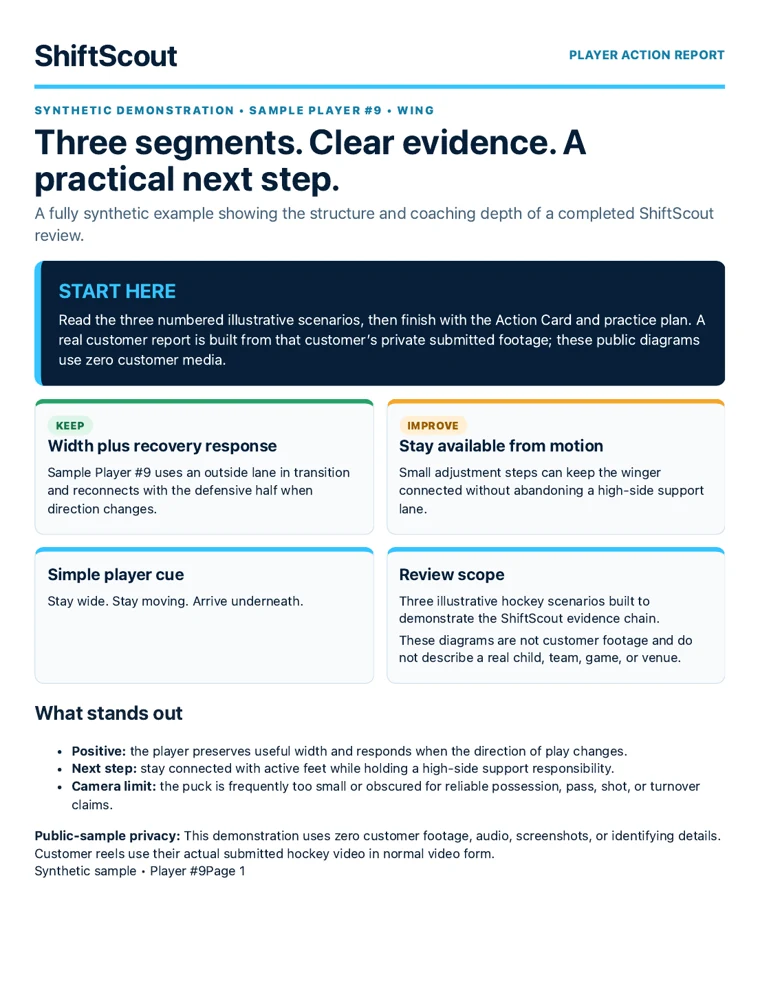
This fully synthetic five-page example shows the structure of a ShiftScout action report without using customer footage or identifying a real player. It demonstrates evidence notes, coaching cues, practice connections, honest limits, and a next-game action card.
Parent questions about hockey video review
Is three shifts enough to evaluate a hockey player?
No. Three shifts are a focused development snapshot, not a complete evaluation, ranking, or recruiting projection. They can still support specific feedback when the player and surrounding play are clearly visible.
Should parents review every mistake with the player?
Usually not. A more manageable conversation starts with one strength, one priority, and one action the player can try during the next practice or game.
Is a highlight reel the same as a development review?
No. Highlights emphasize selected outcomes. Development review needs the setup, decision, surrounding players, and response after the play—not only the most exciting moment.
What makes footage useful for review?
Landscape orientation, steady wide framing, a visible target player, and enough time before and after the shift to understand the sequence.
Want a focused review of your player’s shifts?
ShiftScout by ProspectPath Hockey reviews three submitted shifts using AI-assisted analysis with human identity, evidence, and quality-control verification. The family receives a condensed player-only reel and a coaching-style development report. No account signup is required.